
19 ITEMSVIEW CART


Total: 1,420.00
Expert Support
Full Speed
100% Working
10 USD
Contents:
A
Foreword
1 – User Responsibility
1.1 – Owner’s Responsibility
1.2 – Employer’s Responsibility
1.3 – Trainer’s Responsibility
1.4 – Operator’s Responsibility
2 – Safety
2.1 – Safety Instructions
2.1.1 – Misuse Hazards
2.1.2 – Falling Hazards
2.1.3 – Overturning / Tip-Over Hazards
2.1.4 – Electrocution Hazards
2.1.5 – Explosion / Fire Hazards
2.1.6 – Crushing / Collision Hazards
2.1.7 – Uncontrolled Movement Hazards
3 – Safety Inquiries
4 – Incident Notification
5 – Compliance
5.1 – Product Information
5.1.1 – Change Of Ownership Notification
5.1.2 – Owner Information Update Form
5.2 – Product Specifications
B
Familiarization
1 – General Safety
1.1 – Intended Use
1.2 – Decal Content
1.3 – Symbols And Colors
1.4 – Level Of Severity
1.5 – Symbols Legend And Definitions
2 – Models Description
3 – Primary Machine Components
3.1 – Layout
3.2 – Ground Control Box
3.2.1 – Layout
3.2.2 – Activ’screen
3.3 – Platform Control Box
3.3.1 – Layout
4 – Performance Specifications
4.1 – Technical Characteristics
4.2 – Working Area / Range Of Motion
5 – Decals And Markings Locations
C
Pre-Operation Inspection
1 – Recommendations
2 – Working Area Assessment
3 – Inspection And Functional Test
3.1 – Daily Inspection
4 – Safety Functional Checks
4.1 – E-Stop Button Check
4.2 – Activation Of Controls
4.3 – Fault Detector
4.3.1 – Buzzers Test
4.4 – Overload Sensing System (If Fitted)
4.5 – Slope Warning Device
4.6 – Travel Speed Limitation
4.7 – Electronic Variable Speed Drive
4.8 – Machine Braking
4.9 – Pothole Protection System
4.10 – On-Board Charger
4.10.1 – Battery Charge Level
D
Operation Instructions
1 – Operation
1.1 – Introduction
1.2 – Operation From A Control Box
2 – Ground Control Box
2.1 – To Start And Stop The Machine
2.2 – Mast Movement Controls
2.3 – Additional Controls
3 – Platform Control Box
3.1 – To Start And Stop The Machine
3.2 – Drive And Steer Control
3.3 – Mast Movement Controls
3.4 – Additional Controls
4 – Emergency Procedure
4.1 – In Case Of Power Loss
4.1.1 – Mast Manual Lowering Procedure
4.1.2 – Jib Manual Lowering Procedure
4.2 – To Rescue Operator In Platform
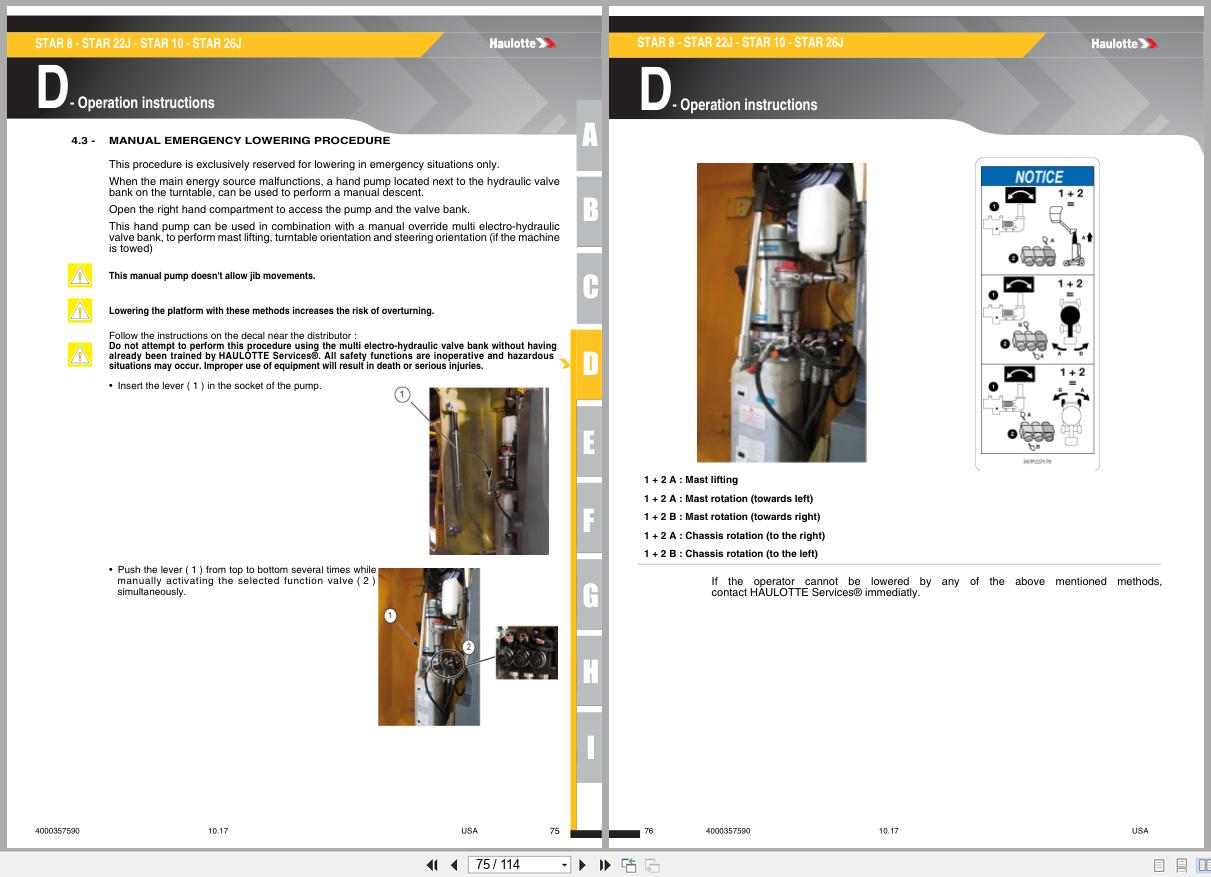
4.3 – Manual Emergency Lowering Procedure
5 – Transportation
5.1 – Putting In Transport Position
5.2 – Machine Layout
5.3 – Unloading
5.4 – Towing
5.4.1 – Electric Brake Release
5.5 – Storage
5.6 – Loading By Ramp
5.7 – Unloading By Ramp
5.8 – Lifting Operation
5.8.1 – Loading And Unloading
5.8.1.1 – Safety Precautions
5.8.1.2 – Necessary Equipment
5.8.1.3 – Preliminary Procedures
5.8.1.4 – Procedure For The Use Of Slings
5.8.2 – Lifting Operation With Tie-Down Points On The Mast
5.8.2.1 – Safety Precautions
5.8.2.2 – Necessary Equipment
5.8.2.3 – Preliminary Procedures
5.8.2.4 – Procedure For The Use Of Slings
5.9 – Loading And Unloading With Forklift
6 – Hydraulic Oil
7 – Battery Care And Maintenance
7.1 – Centralized Battery Refilling
7.2 – Battery Charging
E
General Specifications
1 – Machine Dimensions
2 – Major Component Masses
3 – Acoustics And Vibrations
4 – Wheel/Tire Assembly
4.1 – Technical Specifications
4.2 – Inspection And Maintenance
5 – Options
5.1 – Activ’ Shield Bar – Secondary Guarding System (If Fitted)
5.1.1 – Description
5.1.2 – Characteristics
5.1.3 – Safety Precautions
5.1.4 – Pre-Operation Inspection
5.1.5 – Operation
5.1.6 – Specific Decals
F
Maintenance
1 – General
2 – Maintenance Schedule
3 – Inspection Program
3.1 – General Program
3.2 – Daily Inspection
3.3 – Periodic Inspection
3.4 – Reinforced Inspection
3.5 – Major Inspection
4 – Repairs And Adjustments
G
Other Information
1 – Warranty Disclosure
1.1 – After Sales Service
1.2 – Manufacturer’s Warranty
1.2.1 – Warranty Acceptance
1.2.2 – Warranty Period
1.2.3 – Procedure Conditions
1.2.4 – Conditions Of Warranty
2 – Subsidiary Contact Information
2.1 – California Warning

REALEASE :
REALEASE :

REALEASE :
11.08.2021
REALEASE :
11.08.2021
REALEASE :
10.21.2021

REALEASE :
07.10.2020
REALEASE :
07.10.2020

REALEASE :
29.05.2021
REALEASE :
29.05.2021

REALEASE :
05.04.2022
REALEASE :
05.04.2022

REALEASE :
REALEASE :
REALEASE :
10.21.2021
 Automotive - Heavy Equipment - Truck & Bus - Forklift - Crane
