
0 ITEMSVIEW CART




✓
Expert Support
✓
Full Speed
✓
100% Working
Wacker Neuson Dumper 5000 8002 6000 9002 Operating Manual 1000081409
Size: 19.35 MB
Format: PDF
Language: English
Brand: Wacker Neuson
Type of Machine: Dumper
Type of Manual: Operating Manual
Model: Wacker Neuson 5000 8002 6000 9002 Dumper
Part Number: 1000081409
Publication Date: 2010
Number of Pages: 120 Pages
10 USD
- Description
Description
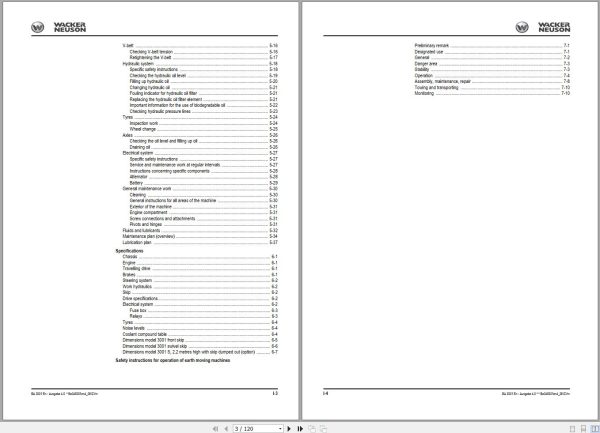
Contents:
Operator’s Manual
Table of contents
1 Introduction
1.1 Important information on this Operator’s Manual
1.2 Brief description
1.3 Regulations
1.4 EC declaration of conformity dumper 3001
1.5 Type labels and component numbers
1.6 Other signs and symbols
2 Safety instructions
2.1 Identification of warnings and dangers
2.2 Warranty
2.3 Designated use and exemption from liability
2.4 General conduct and safety instructions
Organisational measures
Selection and qualification of staff, basic responsibilities
2.5 Safety instructions regarding operation
Normal operation
Trailer operation
2.6 Safety instructions for maintenance
2.7 Warning of special hazards
Electrical energy
Gas, dust, steam, smoke
Hydraulics
Noise
Oil, grease and other chemical substances
Battery
Tyres
3 Operation
3.1 Description of 3001F components (overview)
3.2 Description of 3001S components (overview)
3.3 Control stand overview
3.4 Instrument panel overview
3.5 Putting into operation
Safety instructions
Putting the machine into operation for the first time
Running-in period
Check lists
Start-up checklist
Operation checklist
Parking checklist
3.6 Driving the dumper
Preheating start switch: overview
Accelerator pedal: overview
Telltales and warning lights: overview
Before starting the engine
Starting the engine: general
Procedure
When the engine has started …
Engine warm-up
Jump-starting the engine (supply battery)
Special instructions for driving on public roads
Moving off
Accelerator pedal
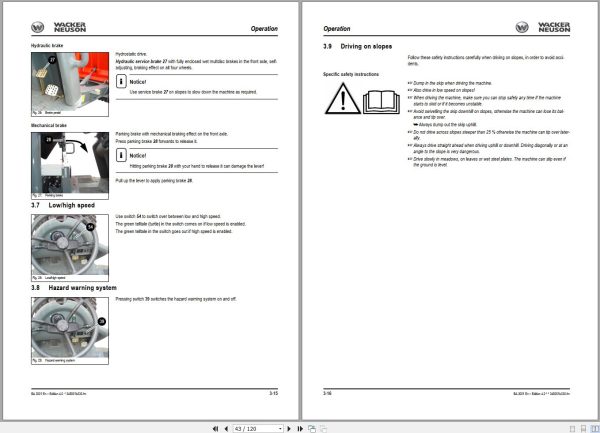
Hydraulic brake
Mechanical brake
3.7 Low/high speed
3.8 Hazard warning system
3.9 Driving on slopes
Specific safety instructions
Driving on slopes with a loaded skip
Driving on slopes with an empty skip
Driving across slopes
Parking the machine
Loading the machine
3.10 Seat adjustment
Weight adjustment
Horizontal adjustment
Backrest adjustment
3.11 Seat belt
Engine cover
3.12 Working with the machine
General safety instructions
3.13 Dumper 3001 front skip operation
3.14 Dumper 3001 swivel skip operation
3.15 Rollbar
3.16 Towing
Opening the high-pressure circuit
3.17 Centre pivot strut
3.18 Locking the control levers
3.19 Crane handling the machine
Machine 3001 S/F
Machine 3001 S (2.2 metres high with skip dumped out)
Loading and transporting the machine
Tying down the machine
3.20 Battery master switch
4 Troubleshooting
4.1 Engine trouble
5 Maintenance
5.1 Introduction
Front skip maintenance strut
Swivel skip maintenance strut
5.2 Fuel system
Refuelling
Stationary fuel pumps
Diesel fuel specification
Bleeding the fuel system
Fuel prefilter with water separator
Replacing the fuel filter
5.3 Engine lubrication system
Checking the oil level
Filling up engine oil
5.4 Engine and hydraulics cooling system
Checking/filling up coolant
5.5 Axle mounting 3001
Front axle
Rear axle
5.6 Air filter
Replacing the filter
5.7 V-belt
Checking V-belt tension
Retightening the V-belt
5.8 Hydraulic system
Checking the hydraulic oil level
Filling up hydraulic oil
Changing hydraulic oil
Fouling indicator for hydraulic oil filter
Replacing the hydraulic oil filter element
Important information for the use of biodegradable oil
Checking hydraulic pressure lines
5.9 Tyres
Inspection work
Wheel change
5.10 Axles
Checking the oil level and filling up oil
Draining oil
5.11 Electrical system
Service and maintenance work at regular intervals
Instructions concerning specific components
Alternator
5.12 General maintenance work
Cleaning
General instructions for all areas of the machine
Exterior of the machine
Engine compartment
Screw connections and attachments
Pivots and hinges
5.13 Fluids and lubricants
5.14 Maintenance plan (overview)
5.15 Lubrication plan
6 Specifications
6.1 Chassis
6.2 Engine
6.3 Travelling drive
6.4 Brakes
6.5 Steering system
6.6 Work hydraulics
6.7 Skip
6.8 Drive specifications
6.9 Electrical system
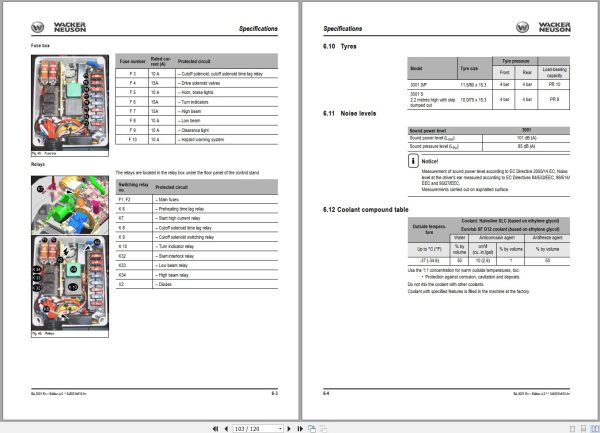
Fuse box
Relays
6.10 Tyres
6.11 Noise levels
6.12 Coolant compound table
6.13 Dimensions model 3001 front skip
6.14 Dimensions model 3001 swivel skip
6.15 Dimensions model 3001 2.2 metres high with skip dumped out (option)
7 Safety instructions for operation of earth moving machines
7.1 Preliminary remark
7.2 Designated use
7.2.1 Earth moving machines may be used only in compliance with their designated use, and by following the instructions given in the Operator’s Manual of the manufacturer.
7.2.2 Designated use means that the earth moving machine is used with the work equipment for work in compliance with the European or national work safety regulations, or that the earth moving machine is used for other work the manufacturer has deemed…
7.2.3 The operator may not carry out any safety-relevant modifications on the earth moving machine without the manufacturer’s authorisation.
7.2.4 Spare parts must comply with the technical requirements specified by the manufacturer.
7.3 General
7.3.1 Earth moving machines may be driven and serviced only by persons who meet the following requirements:
7.3.2 Avoid any operational mode that might be prejudicial to safety.
7.3.3 Do not exceed the authorised load of the earth moving machine.
7.3.4 Operate the earth moving machine only in a safe and reliable state.
7.3.5 Follow the instructions given in the Operator’s Manual of the manufacturer for all work involving operation, maintenance, repair, assembly and transport.
7.3.6 If necessary, the operator must supplement the safety instructions by specific instructions adapted to the local conditions of the work site.
7.3.7 The Operator’s Manual and safety-relevant instructions must be carefully stored in the control stand. The manual and the safety instructions can be stored at the work site itself if the earth moving machine has no cab.
7.3.8 The Operator’s Manual and the safety instructions must be complete and legible.
7.3.9 Do not disable the function of the earth moving machine’s safety equipment during operation.
7.3.10 Wear protective work clothes during work. Avoid wearing rings, scarves, unzipped or unbuttoned jackets. Specific work can require wearing protective goggles, safety shoes, a hard hat, protective gloves, reflective vests, ear protectors, etc.
7.3.11 Get informed on first aid and rescue possibilities (emergency physician, fire brigade, helicopter) before starting work.
7.3.12 You must be familiar with the location and the operation of fire extinguishers on the earth moving machine, and with the local fire alarm and fire fighting facilities.
7.3.13 Secure loose parts, such tools or other equipment, on the earth moving machine.
7.3.14 Secure open doors, windows, covers, lids, etc., to prevent them from closing unintentionally.
7.4 Danger area
7.4.1 All persons must stay clear of the danger area of the earth moving machine.
7.4.2 The machine operator may work with the earth moving machine only if no-one is in the danger area.
7.4.3 The machine operator must give warning signs in case of danger for persons.
7.4.4 The machine operator must stop work with the earth moving machine if persons do not leave the danger area in spite of his warnings.
7.4.5 Do not step onto the articulation of articulation-steered earth moving machines if the engine is running.
7.4.6 Keep a sufficiently safe distance (min. 500 mm) to fixed elements of construction, e.g. buildings, walls to be pulled down, scaffolds or other machines to avoid danger of crushing.
7.4.7 If a safe distance cannot be kept, seal off the area between fixed elements of construction and the work range of the earth moving machine.
7.4.8 If the operator’s visibility onto his drive and work range is impaired by work-specific circumstances, instruct the operator or seal off the drive and work range with a fixed barrier.
7.5 Stability
7.5.1 Always use, drive and operate the earth moving machine ensuring stability and safety from turning over (see also item 7.3).
7.5.2 The operator must adapt his drive speed to the prevailing conditions and lower the work equipment the closest possible to the ground when driving on sloping or uneven terrain.
7.5.3 Follow the instructions given in the specific sections of the Operator’s Manual of the manufacturer when using an earth moving machine equipped with additional outriggers or supporting equipment for increasing stability.
7.5.4 Keep the earth moving machine at a safe distance from the edges of quarries, pits, ditches, slopes or embankments to avoid danger of falling.
7.5.5 When driving or working near excavations, shafts, trenches or the edge of pits and embankments, secure the earth moving machine to prevent it slipping or rolling away.
7.6 Operation
7.6.1 General
7.6.1.1 Machine operators must be appointed by the contractor for driving and servicing the earth moving machine.
7.6.1.2 Controls (operating elements) may be actuated by the driver or from the driver’s seat only.
7.6.1.3 Use the footholds and surfaces provided for to access the machine. Keep them clean to ensure a safe hold at all times.
7.6.1.4 If the work equipment of the earth moving machine can be picked up and set down with a quickhitch, the lock of which cannot be easily seen from the driver’s seat for reasons of design or dirt, take the following additional safety measures:
7.6.2 Transporting persons
7.6.2.1 Apart from the driver, persons may be transported on earth moving machines only if specific places have been provided for by the manufacturer.
7.6.2.2 Persons may access or leave the earth moving machine only after the machine operator has allowed them to do so, and only after the machine is at a standstill.
7.6.3 Drive operation
7.6.3.1 In order to ensure safe work, adjust the seat, the rearview mirrors and the controls before putting the earth moving machine into operation.
7.6.3.2 Fasten the seat belt if the earth moving machine is fitted with a rollover protection structure (ROPS).
7.6.3.3 The windows must clean and free of mist or ice.
7.6.3.4 Do not use cold-starting aids (ether) near heat sources, naked flames or in poorly ventilated premises.
7.6.3.5 The layout of roads and paths must ensure smooth and safe operation, i.e. they must be sufficiently wide, have sufficient load-bearing capacity and the slightest possible slopes.
7.6.3.6 Observe the load-bearing capacity of bridges, basement ceilings, vaults etc., before moving the machine on them!
7.6.3.7 Bear in mind the clear widths and heights of underpasses, tunnels, etc. before driving through them.
7.6.3.8 When driving on steep slopes, carry loads on the uphill side, if possible, in order to increase stability.
7.6.3.9 Do not drive downhill with the clutch disengaged. Shift to a gear adapted to the terrain before driving down a slope, and do not shift gears on the slope.
7.6.3.10 When driving on slopes, select a route that will enable you to brake the earth moving machine safely.
7.6.3.11 Avoid reversing over longer distances.
7.6.3.12 Earth moving machines may be driven on public roads only if the operating and driving licences as defined by national traffic regulations have been obtained for them.
7.6.3.13 When not driving on public roads, e.g. construction sites, apply the road traffic rules accordingly. This also applies to driving permits.
7.6.4 Load and unloading
7.6.4.1 The machine operator may move the work equipment across persons in driver seats or work stations of other machines only if they are protected by canopies (FOPS).
7.6.4.2 If not protected accordingly, the driver of this vehicle must leave the operator’s place if moving the work equipment across his place cannot be avoided.
7.6.4.3 When loading vehicles, make sure they are not overloaded and that they will not loose any material when driving. Load them from the lowest possible height.
7.6.4.4 If possible, the places where material is unloaded should enable the driver to avoid reversing over longer distances.
7.6.4.5 At places where material is dumped, operate earth moving machines only after having taken appropriate measures to prevent the machines from falling down or rolling away under their own weight.
7.6.5 Persons giving instructions
7.6.5.1 Persons giving instructions must be easily visible, e.g. by means of high-visibility warning clothes. They must maintain visual contact with the machine operator.
7.6.5.2 When carrying out their duty, persons giving instructions must not be assigned other tasks that could distract them from their duty.
7.6.6 Operation with risk of falling objects
7.6.6.1 In case of danger of heavy objects falling down, use earth moving machines only if the driver’s seat is equipped with a canopy (FOPS), and with an additional front protection in the case of excavators.
7.6.6.2 When working in front of earth and rock walls, if possible position and operate the earth moving machine with the control stand and the access to the control stand facing the side opposite the wall.
7.6.6.3 Demolition work may be carried out with earth moving machines only if no persons are at risk.
7.6.6.4 When carrying out demolition work with excavators (e.g. with demolition balls), make sure the weight of the ball matches the boom length and the load-bearing capacity of the machine.
7.6.6.5 If possible, the highest point of the work equipment of the earth moving machine must be higher than structure to be demolished.
7.6.7 Working in the area of underground electric lines
7.6.7.1 Before excavating with earth moving machines, find out whether there are any underground electric lines in the work area that might put persons at risk.
7.6.7.2 If there are underground electric lines, determine the positions and the routing of these lines, and define and carry out the required safety measures after having agreed upon these activities with the owner or operator of the lines.
7.6.7.3 Before starting excavation work, clearly mark the routing of lines in the area of the construction site in the presence of the owner or operator. If the position of lines cannot be determined, dig trenches to search for the lines (by hand if …
7.6.7.4 If the machine operator damages or unexpectedly comes across underground electric lines or their protective covers, he must stop work immediately and inform the person supervising the activities.
7.6.8 Working next to overhead electric lines
7.6.8.1 When working next to overhead electric lines and contact lines with the earth moving machine, maintain a safe distance (depending on the rated voltage of the lines) between these lines and the earth moving machine and its work equipment in or…
7.6.8.2 The following safe distances apply in Germany:
7.6.8.3 In doing so, also bear in mind all work movements of the earth moving machine , e.g. boom positions, swinging of ropes and the size of hitched loads. Also bear in mind uneven ground resulting in an inclined position, and hence in a shorter di…
7.6.8.4 If no sufficient distance can be kept to overhead electric lines and contact lines, the contractor must take other safety measures to avoid current transfer after having agreed upon these activities with the owner or operator of the lines. Th…
7.6.8.5 In case of a current transfer or if the machine touches a live wire, the following rules apply:
7.6.9 Operation below ground and in enclosed areas
7.6.10 Breaks/work interruptions
7.6.10.1 During breaks and at the end of a shift, the driver must park the earth moving machine on firm and level ground and secure the machine against unintentional movements.
7.6.10.2 The driver may not leave the earth moving machine if the work equipment has not been secured or lowered to the ground.
7.6.10.3 Park the earth moving machine only in places where it will not pose an obstacle, e.g. to traffic on public roads or construction sites. If necessary, install warning devices, such as warning triangles, warning tape, flashing or warning light…
7.6.10.4 The driver must move all controls to their zero positions and apply the brakes before leaving the control stand.
7.6.10.5 The driver must stop the engines and secure them against unauthorised start-up if he goes away from the earth moving machine.
7.6.11 Applications with lifting gear
7.6.11.1 Applications with lifting gear are understood as procedures involving raising, transporting and lowering loads with the help of slings and load-securing devices (ropes, chains, etc.). In doing so, the help of persons is necessary for securin…
7.6.11.2 The earth moving machine may be used for applications with lifting gear only if the prescribed safety devices are in place and functional.
7.6.11.3 The load must be secured so as to prevent it from falling or slipping.
7.6.11.4 Persons guiding the load or securing it must stay in visual contact with the machine operator.
7.6.11.5 The machine operator must guide the load the nearest possible to the ground and avoid any oscillating or swinging movements!
7.6.11.6 The earth moving machine may be driven with a raised load only if the path of the machine is as level as possible!
7.6.11.7 When using earth moving machines for lifting gear applications, the persons attaching or securing loads may approach the boom from the side only, and only after the machine operator has given his permission. The machine operator may give his…
7.6.11.8 Do not use any lifting gear (ropes, chains) which is damaged or not sufficiently dimensioned. Always wear protective gloves when working with lifting gear.
7.7 Assembly, maintenance, repair
7.7.1 The earth moving machine may be assembled, modified or disassembled only in accordance with the Operator’s Manual of the manufacturer and only under the supervision of suitable staff appointed by the contractor.
7.7.2 For instance, work on the
7.7.3 Stability must be ensured at all times during maintenance work.
7.7.4 Secure the work equipment against movement by lowering it to the ground or by taking appropriate measures, e.g. supporting brackets or sleeves. If necessary, secure the upper carriage of the excavator against rotation.
7.7.5 When carrying out maintenance and repair work on an earth moving machine with an articulated joint, secure the joint with a positive lock when working in the area of the articulated joint.
7.7.6 When installing or removing counterweights, hitch them only at the points provided for by the manufacturer.
7.7.7 When jacking up the earth moving machine, place the lifting device in a position that will avoid slipping. Installing or placing the lifting device in inclined positions is not permissible.
7.7.8 Secure the raised earth moving machine by supporting it with, for instance, supporting frames or trestles, or with boards or square beams stacked crosswise.
7.7.9 Before replacing the bucket blades of scrapers, make sure the buckets are set down on a base avoiding tipping or damage.
7.7.10 Maintenance and repair work on scraper buckets may be carried out only if the lock flap is secured.
7.7.11 Switch off all drives before carrying out maintenance and repair work.
7.7.12 Disconnect the battery before carrying out arc welding or before working on the electrical system of an earth moving machine fitted with an internal combustion engine.
7.7.13 First remove the negative terminal, and then the positive terminal as you disconnect the battery. Proceed in the reverse order as you reconnect the battery.
7.7.14 Cover the battery with insulating material as you carry out repair work in the area of the battery; do not place any tools whatsoever on the battery.
7.7.15 In the case of earth moving machines with electric drives, switch off the electric equipment and if necessary, the movable connecting lines as well, and secure against unintentional or unauthorised start-up.
7.7.16 Open or remove protective devices of moving machine parts only if the drive has been switched off and secured against unauthorised start-up.
7.7.17 Fit all the protective devices back on again correctly once assembly, maintenance or repair work is over.
7.7.18 Welding work on load-bearing elements of the earth moving machine, e.g. lattice booms, loader units, may be carried by only in compliance with the acknowledged welding regulations.
7.7.19 Do not carry out any welding, boring or drilling on rollover protection structures (ROPS) or canopies (FOPS) that could affect the stability of this equipment.
7.7.20 Any modification, such as welding the hydraulic or compressed-air system, may be carried out only with the manufacturer’s authorisation.
7.7.21 Before starting work on the hydraulic system, release the control and the back pressures, and the pressure inside the tank.
7.7.22 Use only the hoses and lines prescribed by the manufacturer.
7.7.23 Install and route hydraulic hoses and lines correctly.
7.7.24 No smoking and no naked flames during refuelling.
7.8 Towing and transporting
7.8.1 Tow the earth moving machine only with a towing facility of sufficient size.
7.8.2 Use the towing points, such as eyelets, hooks, etc., prescribed by the manufacturer.
7.8.3 Move off slowly when towing. All persons must stay clear of the towing facility.
7.8.4 When loading and transporting the earth moving machine, secure the machine itself and the auxiliary means against unintentional movements.
7.8.5 Remove mud, snow and ice from the running gear and the undercarriage of the earth moving machine in order to ensure safe driving on ramps with no danger of slipping.
7.8.6 Place wooden boards on the access ramps of flat-bed trailers before driving on them with tracked machines.
7.8.7 Inspect the planned route before moving off, to make sure the roads are sufficiently wide, that bridges and clearances are of sufficient size and that the roads, paths and bridges have sufficient load-bearing capacity.
7.9 Monitoring
7.9.1 Adhere to the prescribed intervals for routine checks.
7.9.2 Before every work shift, the driver must also check the function of the safety, drive and work equipment, such as the safe load indicator, brakes, steering system and lights in accordance with the manufacturer’s instructions.
7.9.3 Replace hydraulic hosees as soon as the following damage is detected:
7.9.4 Check the coolant level only after the filler cap has cooled down. Open the cap carefully to release overpressure.
7.9.5 The driver must immediately report damage to the person supervising the activities. If drivers change, he must also report to the next driver.
7.9.6 In case of defects affecting the operational safety of the earth moving machine, put the machine out of operation until the defects have been remedied.
Related Products
-
Wacker Neuson 23.1GB PDF Part Manual, Operator Manual, Repair Manual & Wiring Diagram DVD
Original price was: 400.240Current price is: 240. USDWacker Neuson 23.1GB PDF Part Manual, Operator Manual, Repair Manual & Wiring Diagram DVDSize: 23.1 Gb (PDF Files)Language: EnglishFormat: PDFBrand: Wacker NeusonOS: All WindowsQuantity of CD: 1 DVDHigh-Speed link DownloadType of document: Part Manual, Operator Manual, Repair Manual, Electric Diagram, Hydraulic DiagramHot-40%
REALEASE :
01.11.2022
REALEASE :
01.11.2022
-
Wacker Neuson Excavator Deere 26P Parts and Repair Service Manual
80 USDSize: 216.88 MBFormat: PDFLanguage: EnglishBrand: Wacker NeusonType of Machine: ExcavatorType of Manual: Repair Service Manual, Parts Manual, Electric and Hydraulic DiagramsModel: Wacker Neuson Deere 26P Excavator
REALEASE :
REALEASE :
-
Wacker Neuson PDF DVD Collection Service Part & Operator Manual_EN
Original price was: 150.90Current price is: 90. USDWacker Neuson PDF DVD Collection Service Part & Operator Manual_ENSize: 731 MBFormat : PDFLanguage : EnglishBrand: Wacker NeusonNumber of page: 61 FolderAmount of DVD: 1 DVDWindow: All Window 32 an d 64 bitType of machine: Wacker Neuson Heavy EquipmentType of document: Service Part & Operator ManualHot-40%
REALEASE :
14.07.2020
REALEASE :
14.07.2020
-
Wacker Neuson Track Excavator 803 803 Dualpower Service Manual 1000164843
20 USDSize: 9.90 MBFormat: PDFLanguage: EnglishBrand: Wacker NeusonType of Machine: Track ExcavatorType of Manual: Service Manual, Hydraulic and Electric DiagramsModel: Wacker Neuson 803, 803 Dualpower Track ExcavatorOrder Number: 1000164843Number of Pages: 196 Pages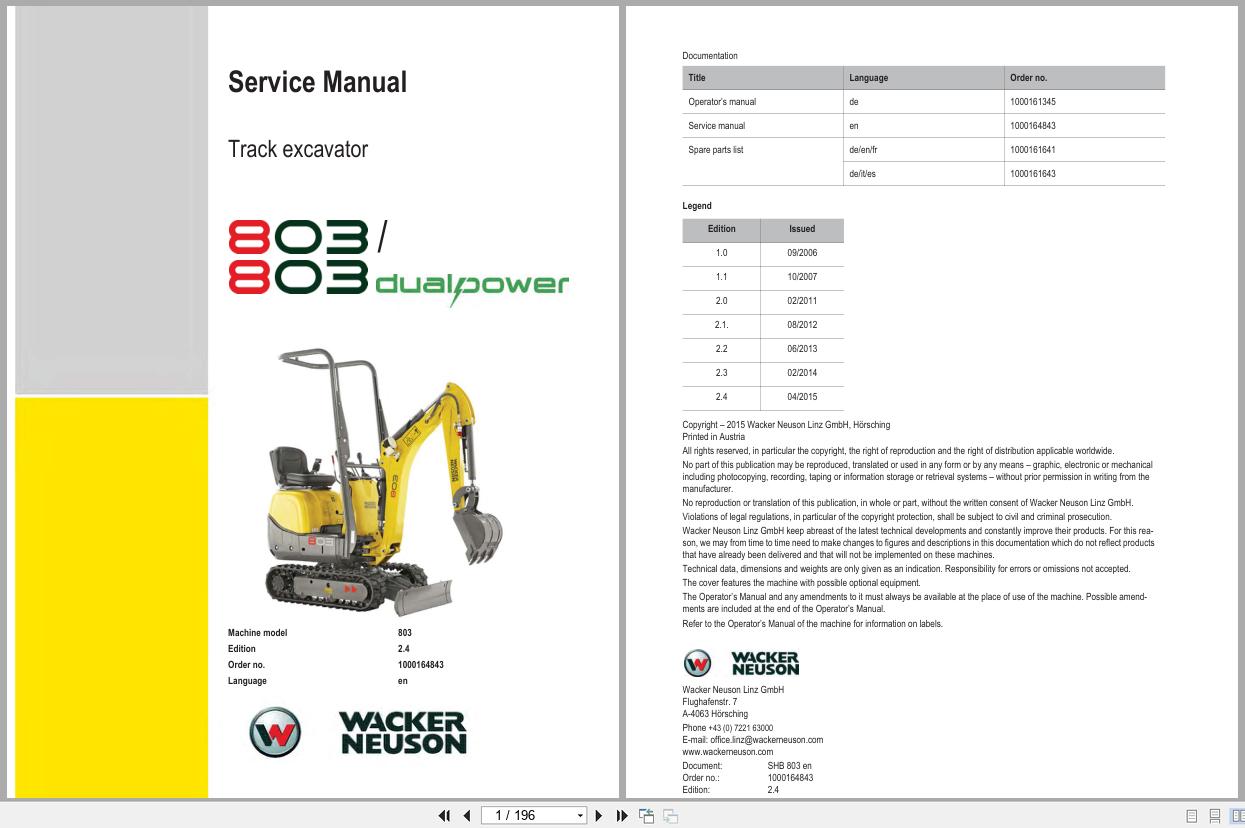
REALEASE :
REALEASE :
-
Wacker Neuson Track Excavator EZ17 Parts and Operation Service Manual
80 USDSize: 134.58 MBFormat: PDFLanguage: EnglishBrand: Wacker NeusonType of Machine: Track ExcavatorType of Manual: Service Manual, Operation Manual, Parts Manual, Electric and Hydraulic DiagramsModel: Wacker Neuson EZ17 Track Excavator
REALEASE :
REALEASE :
-
Wacker Neuson Dumper 1501 D01-05 Spare Parts Catalog 1000165936
Original price was: 20.10Current price is: 10. USDSize: 12.09 MBFormat: PDFLanguage: English, German, FrenchBrand: Wacker NeusonType of Machine: DumperType of Manual: Parts ManualModel: Wacker Neuson 1501 D01-05 DumperPart Number: 1000165936Publication Date: 2016Number of Pages: 255 Pages-50%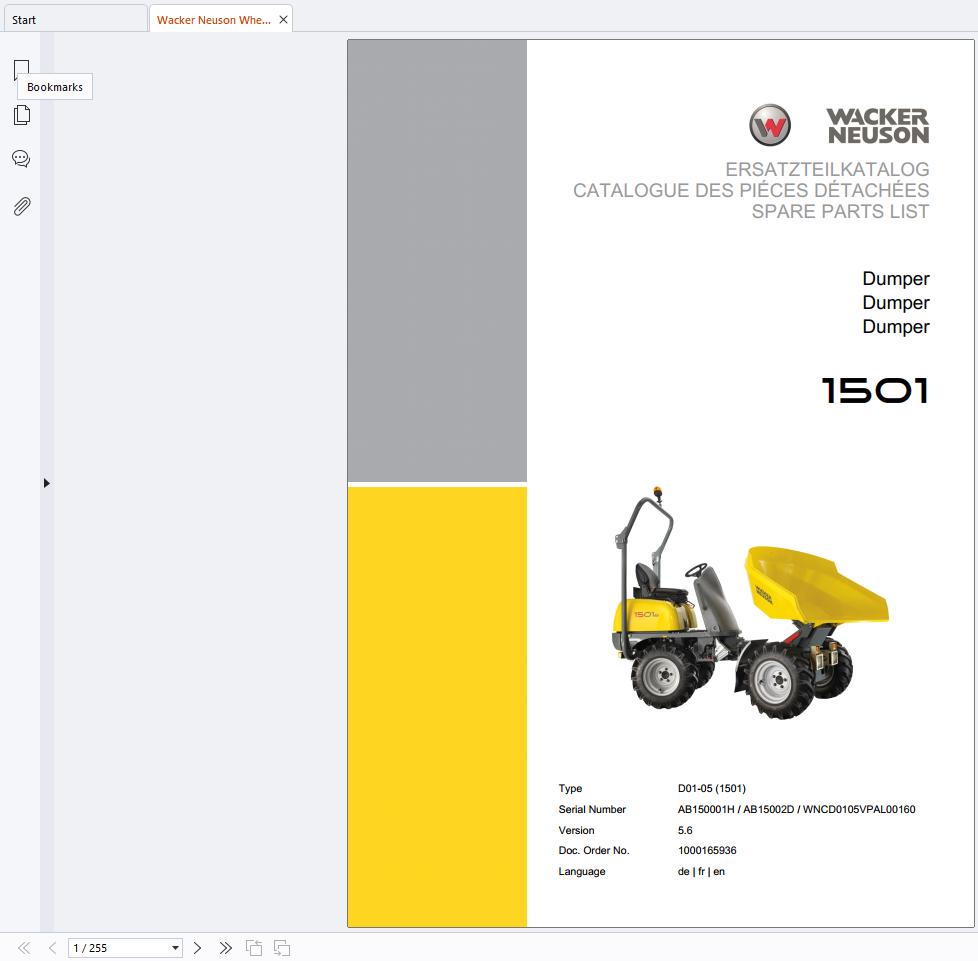
REALEASE :
REALEASE :
-
Wacker Neuson 4.91GB PDF DVD Collection Service Part Diagrams Assembly & Operator Manual
Original price was: 200.140Current price is: 140. USDWacker Neuson 4.91GB PDF DVD Collection Service Part Diagrams Assembly & Operator ManualSize: 4.91 GB (Unpack)Format : PDFLanguage : English, German, FranceBrand: Wacker NeusonNumber of Folder: 1,293 Files, 188 FoldersAmount of DVD: 1 DVDWindow: All Window 32 and 64 bitType of machine: Wacker Neuson Heavy Equipment– Wacker Neuson Dumper– Wacker Neuson Excavator– Wacker Neuson Skid Steer Loader– Wacker Neuson Roller– Wacker Neuson Telehandler…Type of document:– Service Manual– Operating Manual– Spare Part List (English, German, France Langues)– Diagrams– Service News– Assembly InstructionsHigh-Speed link downloadHot-30%
REALEASE :
12.18.2021
REALEASE :
12.18.2021
-
Wacker Neuson Track Excavator EZ26 Operation Service Manual
60 USDSize: 172.34 MBFormat: PDFLanguage: EnglishBrand: Wacker NeusonType of Machine: Track ExcavatorType of Manual: Service Manual, Operation Manual, Electric and Hydraulic DiagramsModel: Wacker Neuson EZ26 Track Excavator
REALEASE :
REALEASE :